Dunning-Kluber Effect 2024

Corey Kluber broke out onto the scene in 2013. Many others, myself included, have looked for a set of statistics that could predict the next Kluber breakout. I’m not sure if he was first, but Big Magoo at Razzball made a valiant early effort. I wrote about it early in the 2022 season here, but I’m going to spruce it up a bit this time, modernize it a bit.

The original criteria was as follows:

  • K/9 > 9
  • SwStr% > 12
  • GB% > 44
  • K/BB > 3

In 2022, I included called strikes + whiffs percentage (CSW%) from the folks at PitcherList due to it’s predictive nature. This year, I’ll switch it up so we use K-BB% instead of K/BB or K/9 as it is a simpler and better as the per-inning metrics can be hiding all sorts of other damage underneath.

I’ll also be adding in Hard Hit % so we can take into account some quality of contact as well. Even if we are keeping the ball on the ground, it’s bound to do damage eventually if they’re getting smoked.

This leaves us with the following criteria for 2024:

  • K-BB% > 14%
  • SwStr% > 12%
  • GB% > 44%
  • CSW% > 30%
  • Hard Hit % < 39%

Without further ado, here are our candidates with a minimum of 100 innings pitched in 2023. We are looking for starters, after all.

NameTeamK-BB%SwStr%GB%CSW%Hard Hit %
Shohei OhtaniLAA2113453035
Pablo LopezMIN2315453035
Blake SnellSDP1815443134
Nick MartinezSDP1413543029
2023 Modernized Kluber Effect – Min. 100 IP

That is a small group, and three of them are well known names that need no introduction. Nick Martinez, on the other hand, is quite the surprise. The 33-year-old debuted with Texas in 2014, struggled for a few years, and wound up in Japan from 2018-2021, signing back into the MLB with the Padres in 2022.

He just signed a new two-year deal with the Cincinnati Reds after giving the Padres two years of ~3.45 ERA ball. This year, and last, ERA estimators such as SIERA and FIP had him being closer to a 4.00 ERA pitcher. The last two years, he has been excellent at inducing chases and keeping his average exit velocity down while being a ground-ball machine.

He’s not going to overwhelm you with velocity, only averaging about 93 mph on his fastball. His premier weapon is his changeup boasting a +11 run value, 46% whiff rate, and a paltry .202 xWOBA against.

Credit: Baseball Savant

With his age and now being in one of the best hitter’s parks in baseball, I’m not convinced that the level of success he’s experienced in the last two years will continue. He has shown he has the ingredients, given he fits these criteria, but the ceiling is too low to consider reaching for him in drafts.

Now, one name is not much to go off of so I wanted to lower the innings threshold a bit. Bringing down the minimum to 80 innings, we get two more names. One more name that may be fitting for a breakout candidate, even on a small scale, and one guy well on his way to the hall of fame.

NameTeamK-BB%SwStr%GB%CSW%Hard Hit%
Tyler HoltonDET1712463032
Clayton KershawLAD1913483039
2023 Modernized Kluber Effect – Min. 80 IP

Tyler Holton, 27, of the Detroit Tigers was first brought to my attention by Alex Chamberlain on Twitter a few weeks ago. He polled to ask if he was rostered and only 8.5% of responses had him rostered. Granted, Holton is not a starter and continues to project as a long reliever, but on the off-chance he does get a chance to start, he is on the right path.

Just like Martinez, he’s not going to blow it by you with a 91 mph fastball. That doesn’t mean his fastball isn’t valuable as it had a +9 run value with an xSLG of just .373 against. He doesn’t walk anyone and is in the 93rd percentile of average EV. He was a top-75 pitcher last year and it would be a mistake to ignore him at this point. There is tons of value in non-closer relievers, but that is a topic for another day.

In conclusion, there wasn’t much activity with the Kluber criteria in 2023. Nick Martinez and Tyler Holton were the only non-household names to be found, and they aren’t slated to set the world on fire. They did find themselves in good company, nonetheless. Maybe 2024 will have another can of worms for us to open up.
In Perspective – Outfield Rankings 2023

As the 2024 season is beginning to come in to line of sight (what’s a superb owl?), now’s as good time as any to take a look back to see how we did when ranking guys before the 2023 season. Outfielders will start us out, and we will run around the diamond for the other positions, don’t worry. There was quite an explosion of stolen bases and some mighty swings of the bats to get some higher than expected home run totals, but let’s give it a rundown to see exactly where we succeeded and failed.

As a reminder, the top 25 outfielders I had coming in to 2023 were as follows with their ending rank per Fangraphs auction calculator (OF only, standard 5×5):

RankName2023 Finish+/-
1Juan Soto6-5
2Aaron Judge18-16
3Julio Rodriguez3
4Ronald Acuna Jr.1+3
5Kyle Tucker5
6Mookie Betts2+4
7Mike Trout76-72
8Yordan Alvarez14-6
9Kyle Schwarber13-4
10Bryan Reynolds20-10
11Corbin Carroll4+7
12George Springer23-11
13Michael Harris II28-15
14Randy Arozarena17-3
15Brandon Nimmo27-12
16Luis Robert Jr.9+7
17Cedric Mullins49-32
18Byron Buxton236 (DH)tons
19Jeff McNeil51-32
20Masataka Yoshida34-14
21Tyler O’Neill150-129
22Taylor Ward77-55
23Steven Kwan41-18
24Teoscar Hernandez22+2
25Adolis Garcia8+17
Difference between 2023 pre-season rank and end-of-season rank.

At a glance, I don’t feel too bad about how it turned out. There were some big misses and some right on the nose. Buxton only played 85 games, none of which were in the outfield, and O’Neill only played in 72 games after missing some time with back and knee issues. Between the two of them and Trout, it’s quite clear that I need to be more cautious when it comes to injury-prone players. Taylor Ward was the only other huge miss by 55 spots, though he did only play in 97 games as well after getting hit in the face by a pitch.

On average, players ended about 25 spots lower than I ranked them. Without the major injuries, it comes up to about 17 spots lower than pre-season. A median of 10 spots lower has me feeling good, with the caveat of small sample size, of course.

Without taking into consideration any injury, Jeff McNeil and Cedric Mullins tied for my worst ranks, finishing 32 spots below my estimate. Hindsight being 20/20, I was quite bullish on McNeil. He finished with 10 homers and stolen bases while slashing .270/.333/.378. Poor exit velocity and a consistently low walk rate should have been an eye-opener. The batting average I thought would be there tanked over 56 points from 2022 with the rest of his slash line following a similar trajectory. A 65 point drop in BABIP from .353 to .288 has a non-zero effect on things, but again, the poor barrel percentage, hard hit rate, etc. are easy things to point to explaining that precipitous drop. Projection systems for 2024 show a similar counting stat line to 2023 with a slight improvement on the average up to around .285.

Mullins was a victim of the crowded Orioles system and a couple groin strains that limited him to 116 games. In that limited action, the 28-year-old posted solid counting stats with 51 runs, 15 homers, 74 RBI, and 19 stolen bases while slashing .233/.305/.416 good for a .721 OPS, identical to 2022. While the 30 homers from 2021 is likely an outlier, the stolen bases should continue to be there. He both walked and struck out more this year and pulled the ball at the second-highest clip of his career at 44.5% of the time. His fly ball percentage is up 5 percent from 2022 as well, lending to the idea that a lot of hitters are taking to these days, hit it high and pull it to sell out for power.

The best predictions for the year were Julio Rodriguez and Kyle Tucker, finishing at 3 and 5, respectively. The top end guys can be some of the easier gets due to their consistency and being top guys for a reason. I consider Kyle Schwarber, Randy Arozarena, and Teoscar Hernandez to be better hits, all coming within 4 spots of my initial rankings. The lower down the list you go, the more valuable it can be to be correct. The actual evaluation of that premise would be better suited when comparing to other projections, that’s a little outside the scope of this piece at the time.

Corbin Carroll, Luis Robert Jr., and Adolis Garcia all did at least 7 spots better than my rankings, and I don’t think a single one of them comes as a surprise. The talent has always been there for Carroll and Robert, one’s just a rookie and the other had to battle injuries to get here.

Adolis is going to be on the wrong side of 30 soon, but by golly does he smoke the ball. A barrel percentage and avg exit velocity in the mid 90 percentiles with excellent defense will keep you in the lineup. Projections for him in 2024 have him hitting just over 30 homers with 13 or so stolen bases. After going 27/25 in 2022, I think I will agree with the projections for 2024 and slot him around the number 10-12 outfielder in my next ranking.

All in all, we had some new names crop up in 2023 like Lane Thomas and Spencer Steer staking their claims while the young stars continue their dominance. Several bats in Cincinnati came out hot and will look to continue their breakouts. Michael Harris II was a tale of two halves in 2023, and I’m excited to see what he puts together in 2024. Ranking guys is hard, but I’ll be damned if I don’t try it all again this year.

Too Early 2024 – Top 12 Second Base

Moving right along the infield from first to second base, we are met with some familiar faces, some new ones, and an MVP candidate from the top rope. Names like Marcus Semien, Gleyber Torres, and Ozzie Albies did what they were projected to do. Guys like Nico Hoerner and Bryson Stott went above and beyond their expectations this year. And then there was Mookie. Let’s jump into it! This ranking is for traditional 5×5 categories.

2024 Top 12-Second Basemen:

  1. Mookie Betts, 31 – LAD; .307/.408/.579 – 126/39/107/14 in 693 PA
    • What is there to even left to say about Mookie? While this year may not have been as stat stuffing as his 2018 campaign where he went .346/.438/.640 with 129/32/80/30, he certainly came close. A five-category contributor with excellent plate discipline, quality of contact, and solid defense, he’s a no-brainer.
  2. Ozzie Albies, 26 – ATL; .280/.336/.513 – 96/33/109/13 in 660 PA
    • The young star alongside Ronald Acuna Jr. in Atlanta has had high expectations since he signed a 7yr/$35 million deal in 2019. Atlanta showed commitment to their young core and so far, they’ve returned the favor in spades. Ozzie has shown more power than most anticipated when he came up while maintaining a solid .273 career avg. This year was a return to form for him after an injury-riddled 2022. He hits the ball hard enough to get through gaps and does a great job of hitting the sweet spot (launch angle between 8 and 32 degrees) at a 37.4% clip. I anticipate Albies continuing this level of production as he enters his prime.  
  3. Marcus Semien, 33 – TEX; .276/.348/.478 – 122/29/100/14 in 753 PA
    • The slugging second basemen in Texas signed a huge deal last year that keeps him in Texas alongside Corey Seager for many years to come. He has made 700 plate appearances 5 of the last 6 years (2020 shenanigans) and has hit more than 26 homers in each of those seasons. He will be at the top of a potent Rangers lineup and keep getting years of +200 R+RBI while throwing in 10-15 stolen bases. His biggest knock is his age and quality of contact, which he has not been known for, historically.
  4. Jose Altuve, 33 – HOU; .311/.393/.522 – 76/17/51/14 in 410 PA
    • Altuve has been doing this a while now and has been a consistent stat-grabbing presence atop the Houston lineup. He doesn’t play nearly as much as our previously mentioned Semien, only averaging 125 games the last three years thanks to a hand injury this year. In that limited time, though, he gets you 25-30 home runs with +150 R+RBI and (more recently) ~15 stolen bases. He doesn’t run nearly as much as he used to, but that’s to be expected with age. His expected batting average this year was 53 points below his actual and expected slugging 98 points below. The plate discipline is still there and with the new rules, the steals should stay, but don’t expect 30 homers again.
  5. Gleyber Torres, 26 – NYY; .273/.347/.453 – 90/25/68/13 in 672 PA
    • Pre-season projections were very close on Gleyber’s HR, RBI, and SB while underestimating his AVG, and PA. It was a very similar season to last year as well in all but R. His expected stats all show a little positive regression and are close in value, meaning that this year is not attributed to luck or many other outside factors. He has good plate discipline and could barrel the ball a little more frequently, but not a huge knock given we are getting 20-25 HR. A solid contribution in all five categories is worth the five-spot going into 2024 when he’ll be 27 and in his prime.
  6. Ketel Marte, 29 (few days from 30) – ARI; .276/.358/.485 – 94/25/82/8 in 558 PA
    • Ketel was coming off a down 2022 and a disappointing 2021 where he was hitting well and injury derailed a good season, so it was almost surprising to see some power return to the tune of 25 long balls this year. It wasn’t quite his 2019 where he hit 32 homers while also hitting .329, but .276 this year is not terrible. Arizona was hot through June, went on a slide, then turned on the jets again to make the Wild Card which allowed Marte to get to 94 runs, only three away from his career high in 2019. He out hit all pre-season projections, and I think he will find an in-between his pre-season projections and final results as he crests the hill of his prime.
  7. Jazz Chisholm Jr., 25 – MIA; .250/.304/.457 – 50/19/51/22 in 383 PA
    • Jazz is a polarizing player in that the talent is visible, but he can’t manage to stay on the field. In 383 plate appearances, he almost had a 20/20 season and over a full 650 plate appearances, that’s close to 30/30. He hits the ball harder than most 2B but has terrible launch angle, whiffs and strikes out tons. With an expected batting average and slugging 20 points lower than his actual, the line comes down and is not encouraging. If you are willing to take the risk on the 30/30 upside, have at it.
  8. Zack Gelof, 23 (soon to be 24) – OAK; .267/.337/.504 – 40/14/32/14 in 300 PA
    • Oakland has been the land of nothingness in their relocation debacle, should they stay or should they go thing. Gelof is a bright spot in Oakland (may have to compete with Vegas lights soon) as he burst onto the scene with a 14/14 rookie campaign. ZIPS was the most aggressive pre-season projection projecting him for 399 PA hitting .217 with 43/11/38/6. He beat those projections, to say the least. No one will be pressing him for playing time next year as Oakland will likely be another bottom feeder if not the worst team in the league. His biggest knock is the whiffs and K-rate, which will almost always be a challenge for rookies adjusting to major league competition. He had 20 steals in as many PA in AAA this year, so I’d expect the steals to continue in the majors next year. 20/30 is easily in the realm of possibility, but the average may suffer closer to .230.
  9. Edouard Julien, 24 – MIN; .263/.381/.459 – 60/16/37/3 in 408 PA
    • Another rookie, this time in the Twin Cities, that has exciting potential. Julien hits the ball much harder than Gelof and has just as poor whiffs and K-rate. However, he has 100th percentile chase % and 98th percentile BB% at 15.7%. He will be a better play in OBP leagues than AVG. He also has similar drops in expected average, slugging, and WOBA as Gelof, so he may not come out of the gates hot next year, but 20/10 kind of year with an OBP of around .370 isn’t out of the question.
  10. Muncy, 33 – LAD; .212/.333/.475 – 95/36/105/1 in 579 PA
    • Muncy is what Joey Gallo wishes he could be, a +30 HR hitter while hitting above the Mendoza line. He mostly spends time at third, but snuck in 25 games at 2B this year to become eligible next year. He will be an eyesore in AVG leagues, and about average in OBP while giving you homers and +180 R+RBI while hitting in the stacked Dodgers lineup. The barrel rate and exit velocities are great, and he pulled the ball over half the time he made contact, leading to most of his home runs being on the pull side. A solid backend option if you miss out on the top end.
  11. Arraez, 26 – MIA – .354/.393/.469 – 71/10/69/3 in 617 PA
    • A hitting machine that is in an annual run for the batting title, Arraez gives you nothing much else. He hardly walks or strikes out and being atop the Miami lineup he won’t get you any RBI and limited runs due to their bottom-5 offense. He doesn’t steal, and he was lucky to hit 10 home runs this year. He’s a safe anchor for AVG, but doesn’t offer much upside.
  12. India, 26 – CIN – .244/.338/.407 – 78/17/61/14 in 529 PA
    • I saw an article earlier this year that pegged India as the most average hitter in the league and that is exactly the feeling you get when you see the stat line. A 99 wRC+ (where 100 is average) backs that up as well as his slash line within 4 points on average, 18 points in OBP, and 7 points in slugging compared to league average. He doesn’t wow you with any tools, but he’s a solid contributor all around pushing 15/15 as long as he stays healthy. The only thing he’s elite on is his chase % at 19.6%, good for 93rd percentile. There is upside with other rookies or prospects that could easily outshine him next year, but if you need a safe option for production, India’s your guy.

Second base is a bit top-heavy but generally solid all around. Some guys may make the jump to make it not so top-heavy and others may age out or lose eligibility quickly. Justin Foscue (TEX) and Nick Loftin (KC) are a couple of names that may make a name for themselves this year, like Zack Gelof and Edouard Julien.

Too Early 2024 -Top 12 First Base

UPDATE 10/8: Added Bryce Harper (3) and Cody Bellinger (8) after I originally chose to omit them since they are may not primarily play 1B next year. This doesn’t mean they aren’t fantasy eligibile at 1B and should be ranked accordingly.

Now that the playoffs are in full swing, we have a chance to look back at 2023 and get ahead on our 2024 rankings. We’re going to start this series off at first base and work our way around the diamond. There were a few surprises at first base this year thanks to injuries and age of old. Guys like Rhys Hoskins and Vinnie Pasquantino were out most of the year and others like Jose Abreu are just getting up there in age. The top twelve first baseman coming into 2023 ranked by Fangraphs went as such:

  1. Vladimir Guerrero Jr.
  2. Freddie Freeman
  3. Paul Goldschmidt
  4. Pete Alonso
  5. Matt Olson
  6. Nathaniel Lowe
  7. Jose Abreu
  8. Christian Walker
  9. Rhys Hoskins
  10. Vinnie Pasquantino
  11. Ryan Mountcastle
  12. CJ Cron

Of these twelve, only six ended up in the top 12 per the Fangraphs auction calculator. Nathaniel Lowe, Jose Abreu, Rhys Hoskins, Vinnie Pasquantino, Ryan Mountcastle, and CJ Cron fell out either due to performance or injury. The top 12 per the Fangraphs auction calculator looks like this:

  1. Freddie Freeman
  2. Bryce Harper
  3. Matt Olson
  4. Pete Alonso
  5. Vladimir Guerrero Jr.
  6. Paul Goldschmidt
  7. Christian Walker
  8. Cody Bellinger
  9. Yandy Diaz
  10. Luis Arraez
  11. Salvador Perez
  12. Josh Naylor

This ranking is thrown off by players that did not have first base as their primary position this year. Most notably Bryce Harper who came back from Tommy John (primarily outfield but came back to play first so he could come back from injury faster), Cody Bellinger who split time between center field and 1st, Luis Arraez who spent time at second base and Salvador Perez who was primarily a catcher.

If we adjust the ranking to show the players that primarily played first base, it looks like this:

  1. Freddie Freeman
  2. Matt Olson
  3. Pete Alonso
  4. Vladimir Guerrero Jr.
  5. Paul Goldschmidt
  6. Christian Walker
  7. Yandy Diaz
  8. Josh Naylor
  9. Josh Bell
  10. Jose Abreu
  11. Ryan Mountcastle
  12. Nathaniel Lowe

Spencer Torkelson and Andrew Vaughn are close behind Nathaniel Lowe. Now with this ranking in mind, we can take into consideration injuries, prospects, and gut feelings to give us this list here below (stats from 2023):

2024 Top 12 – 1B

  1. Freddie Freeman – LAD; 131/29/102/23/.331
    • What’s not to love about Mr. Freeman? A true 5 category contributor with over 230 R+RBI, almost a 30/20 season, and hitting well above .300 there’s not much more you could ask for. The only concern is he’s 34 now and will turn 35 at the end of next year. But the good thing is he has shown no sign of slowing down since he turned 30. He’s a lock for 25 home runs over 200 R+RBI and hitting around .300 in a vaunted Dodgers lineup.
  2. Matt Olson – ATL; 127/54/139/1/.283
    • We knew Olson could slug, but 54 home runs is quite a feat. Leading a historic Braves offense to 307 home runs, we can feel free to expect another 40 next year. Most of the Braves lineup surrounding him will be the same as this year so we can expect a similar number of runs and RBIs as well. With over 260 R+RBI, he is right up there with Acuna as the Brave to have. Unfortunately, he does not have Mr. Freeman’s penchant for the base paths, but a .993 OPS is a worthwhile reward. Next year we can expect similar numbers except for maybe dropping his average 10 to 20 points.
  3. Bryce Harper – PHI; 84/21/72/11/.293
    • Harper was in the midst of recovering from Tommy John and decided he can play 1B to come back faster. Boy, was that a good decision. Primarily a RF before the surgery, he had some “good” timing with Rhys Hoskins going down for the year to have a spot to take over in the infield. Everyone knows the name Bryce Harper, he’s been hyped since he was 16 years old. He’s going to give you 30+ HR, 85+ RBI, and 10+ SB to go along with a great slash line. The main knock is he chases and whiffs a lot, 21st and 11th percentile, respectively. He hits the ball hard, in the sweet spot, and in the right places while walking at an excellent 14.7% rate and limiting Ks to a stomachable 21.8%. He’ll bring 1B eligiblity into next year and we’ll have to see how the outfield shakes out next year to see if he returns to right at any point.
  4. Pete Alonso – NYM; 92/46/118/4/.217
    • If Peter Alonso is known for one thing, it’s his power. He’s almost a straight lock for 40 plus home runs, and well over 100 RBIs. The downside this year was his average at a paltry .217. His expected batting average was .244 meaning not all was lost in terms of quality of contact, but his .217 is well down from his .271 posted last year. He still slugged over 500 and had an xWOBA of .370 with a BABIP of .205. He is still mashing the ball and got unlucky in terms of balls in play. The last two years his BABIP was in the .270s so this alone should be a sign of better things to come.
  5. Vladimir Guerrero Jr. – TOR; 78/26/94/5/.264
    • Vlad had big expectations coming into this year, as did everyone else on the Blue Jays. It wasn’t the worst year by any means, but it was a disappointing year. After hitting over thirty home runs last year and 48 the year before, we were expecting Vlad to at least clear 30 again this year while contributing to what should have been a scary Toronto offense. The team was 12th by xWOBA to finish 2023 trailing teams like the Cardinals, Twins, and Cubs. His quality of contact remains excellent with an expected batting average of .291 and an xWOBA of .374. He’s also 89th percentile in hard hit percent and 91st percentile on average exit velocity. Perhaps some of the changes to Roger center could explain part of the decline as he hit .238/.324/.391 at home versus .289/.360/.494 in away games. I’m still in on Vlad because he’s too young and too talented to give up on just yet.
  6. Paul Goldschmidt – STL; /89/25/80/11/.268
    • Being 35 years old isn’t the end of the world but it’s not the greatest thing in the world of baseball. It’s starting to seem like father time is coming for Paul. Last year, he was able to hit .317 but with an expected batting average of .261 we knew it wasn’t going to last. This year confirmed it when he hit .268 with an expected batting average of .267 and struck out more than he has since 2019 when he joined St. Louis. He still contributed valiantly to home runs and stolen bases, but the runs and RBIs were down from over 100 in each category last year. Goldschmidt has been up there in the same conversations as Freddie Freeman, posting thirty home runs and ten plus steals while hitting .300, but after so much time your body begins to betray you.
  7. Christian Walker – ARI; 86/33/103/11/.258
    • I was not in on Christian Walker last year, nor was I in on him this year, but he has proved me wrong. Back-to-back years of 85 runs, over thirty home runs, around >90 RBIs with a few stolen bases and hitting .250 with data to back it up is a solid recipe for success. His statcast numbers were better overall last year but he remains consistent and will be a solid option moving forward until father time takes its toll.
  8. Cody Bellinger – CHC; 95/26/97/20/.307
    • Bellinger has had quite the career so far. His first three years in the league as a Dodger he won Rookie of the Year and an MVP. The three years following, he was one of the worst hitters in baseball, mediocre, and now back to stardom with a resurgent 20/20 year with the cubs while hitting .307. Now, his expected stats do show some regression coming, namely in his slugging which had a difference of 75 points. His BABIP was normal at .319, it’s the quality of contact that will be the source of regression. He had a hard-hit % of only 31.4, good for 10th percentile and had a low average exit velocity of 87.9 mph, good for 22nd percentile. He is a great fielder and shows good speed so the power and average may not return to this level, but he will be a good option moving forward if the changes he made this year can be sustained. Good to have him back.
  9. Josh Naylor – CLE; 52/17/97/10/.308
    • Naylor is one of those guys that I have had a gut feeling on for the last few years. He’s just a solid all-around contributor except for the runs category thanks to Cleveland’s putrid lineup. He’s almost like Paul Goldschmidt and Freddie Freeman lite getting you around 20 home runs, ~80 RBIs and nearly 10 stolen bases while hitting close to .300. He has solid plate discipline with a 7.1% walk rate for his career and he does not strike out nearly as much as his contemporaries at only 13.7% this year and a career 16.5% rate. I believe he will continue to build on what he accomplished this year and could push a 25/15 season next year if he stays healthy.
  10. Yandy Diaz – TBR; 95/22/78/0/.330
    • Yandy had one of those years that make you go, “who?”. He’s been with the Rays for 5 years now and hasn’t been anything special until he was able to put it together this year. Two of the last three years he hit close to .300 but had nothing else to show for it aside from 13 homers in 2021. In the fantasy community, people started talking about how he needed to lift the ball more to be productive, and he did just that this year leading to his 22-homer campaign. This year did not, however, come without some luck to the tune of a .367 BABIP compared to his career .326 and struggles to consistently lift the ball. He, like so many other Rays, started out hot then his FB% tailed off dramatically after 20 games and didn’t come back up until the second half to stabilize at around 29%. If he can keep up his quality contact and continue to lift the ball, we could see an easy repeat of this year and maybe more.
  11. Spencer Torkelson – DET; 88/31/94/3/.233
    • Torkelson had a year that was leaps and bounds ahead of where he was last year and still has room for improvement. After hitting just .203 last year with only eight home runs and 28 RBIs, to turn around and hit over 30 this year is finally getting in line with the expectations after being one of the best college hitters of all time and being a “can’t-miss” prospect. His slash line went from .203/.285/.319 to .233/.313/.446 with a 15 point improvement in BABIP and keeping his solid plate discipline at around a 9% walk rate and 25% K rate. The expected stats show a 34 point slugging difference and a 23 point WOBA difference and he increased his barrel % from 8 to 14, meaning the contact has been good enough that with some extra balls going his way next year, he’ll be off to the races. The main concern is the whiffs and struggles with slider/changeup but let’s see if another off season can make the difference.
  12. Vinnie Pasquantino – KC; 24/9/26/0/.247
    • I’m a hometown fan of the Royals, but I’ve got some cold water for Vinnie. That’s shoulder surgery that kept him out for most of the year. He tore his labrum in his leading shoulder for his swing, an injury that can easily sap power. The good news is that a shoulder injury doesn’t change his eye at the plate. He is one of the best add limiting whiffs and keeping his strikeout rate down. Last year he didn’t qualify but he was near the top in several batted ball quality metrics such as xWOBA, expected batting average and hard-hit percentage. Before his surgery, his barrel rate was even lower than it was last year, which was already middling, and chased the most in his career. He is still young and one of the better hitters in the Royals lineup so he will get plenty of opportunity, but I am skeptical of the shoulder injury and its impact.

Honorable Mention:

With the addition of Harper and Bellinger, Casas and Lowe were the first out. I’ve already gotten flak about Casas being too low, and I may end up moving him up as the off-season progresses, but for now, he’s relegated.

  • Triston Casas – BOS; /66/24/65/0/.263
    • Casas had a year that was a tale of two halves. In the first half he hit .225/.330/.398 with 9 HR, 26% K-rate, and a 97 wRC+ (100 being league average). In the second half he hit .317/.414/.617 with 15 HR, 23.7 K%, and a 174 wRC+. He destroyed the baseball and had some help with a .365 BABIP, but a .300 ISO and 1.031 OPS speak for itself. His hit tool has always been a question and he is only 23 years old so there is time for further improvement. He is swinging more and more aggressively as his First Pitch Swing% went from 23.2 to 27 percent this year while his overall swing percentage went from 37.9 to 43.6, a noticeable jump. He struggles in the shadow zone (near the edges) so if pitchers can show great command, he can be picked apart. We will have to see if he trades some of his patience for aggression to rack up even more stats.
  • Nathaniel Lowe – TEX; 89/17/82/1
    • Lowe has only gotten worse in just about every category since last year. His R and RBI are similar, but this is likely more thanks to being in the dangerous Rangers lineup than it is from his own accord. His AVG, SLG, WOBA, wRC+, HR, and Barrel% are all way down. From last year to this year, he has seemed to have trade quality of contact for plate discipline as he was great at not chasing and had a 90th percentile 12.8 BB%. He hit 10 fewer HR, slugged 78 points lower, and dropped his hard-hit rate by 3 points. In fantasy, you must hit to be considered for a starting first base job, just like real life, but Mr. Lowe is on the cusp of being let go.
  • Bryce Harper would be number 3 for me if I could say for sure he was going to play first next year. He played 36 games there this year as he came back from Tommy John he underwent last year, but Philly already has Castellanos, Marsh, Schwarber, Pache, and Rojas to take OF at-bats. For now, I’m going to put him in RF where he has played the most the last several years.  

Hitters Stock Market

Now that the season has begun, here in the middle of week 3, some pictures are starting to form of who’s hot and who’s not. With such a small sample size, it’s easy to get swept up in the hype, rush to the wire, and add the latest flavor of the week. As many of you know, baseball is a marathon, not a sprint. It pays to pay attention to the legitimacy of these guys’ stats and act before it comes crashing down or catch a ride on the way back up for others. Here we are going to take a look at four guys to sell, if you can, and four guys to buy with better days ahead of them.

SELL

Chas McCormick – 37 PA – .258/.361/.516 – 5/2/7/3

  • Mr. McCormick came into the year projected to mostly split time in CF with Jake Meyers getting close to 400 PA. The BAT X with a line of .238/.315/.391 and 13/54/49/8. He’s obviously off to a hot start, but there isn’t much to back it up. Zero barrels on the year, Hard Hit % of 32 (below 36 league avg.), and to cap it off, a xAVG of .139 and .222 xSLG. He’s also got a .316 BABIP, which is close to average, so there isn’t even luck to be had. Try to hop off the train if you can.

Trevor Larnach – 46 PA – .308/.413/.436 – 5/1/8/0

  • Larnach was a hot waiver target in week 2. He went 9 for 24 with his one HR and 5 RBI in the first 5 games. A career line of .234/.324/.377 meant that the hot start hinted at the long sought breakout as he’s been on sleeper lists for the last few years but hasn’t quite been able to figure it out. While his walk rate keeps him somewhat valuable in OBP leagues, he’s still on the way down when it comes to making contact. He strikes out at a 30% clip, and a .458 BABIP with a single barrel on the year contributes to his .225 xAVG.

Myles Straw – 46 PA – .343/.489/.400 – 7/0/4/6

  • Straw has turned out to be exactly what we expected and more to start off the year. Coming out the gates blazing with 6 SB, he has surprised with the ability to make contact and get on base, though the slugging has continued to lag behind substantially. He has superb plate discipline with a 9:9 K:BB and hardly chases or whiffs. Unfortunately, the lack of hard contact (26%) is going to bring his average back down to earth, and his on-base with it. A ballooned .462 BABIP also points to regression. He will continue to steal bases at a high rate when he does get on, projected for another 25 or so.

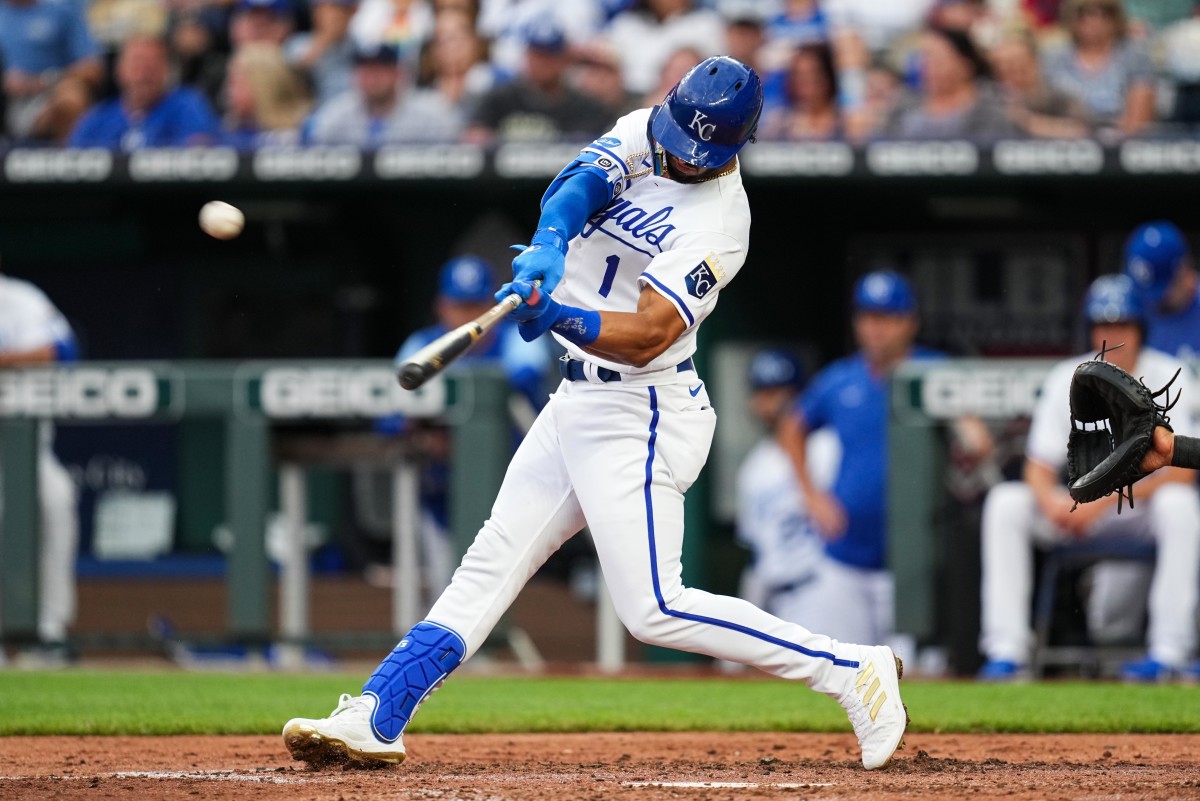
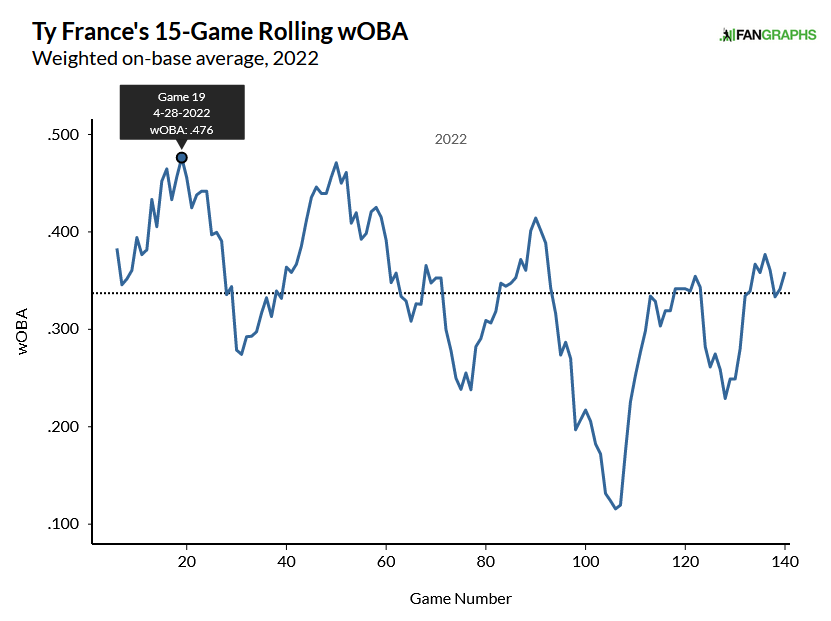
Ty France – 52 PA – .313/.365/.500 – 10/1/6/1

Baguette Man got off to a torrid start last year as well:

  • France is off to a similar start in terms of average and overall production minus the homers. A WOBA of .377 and xWOBA of .315 mean his production will continue to taper off, but will still be serviceable. If you are in roto leagues and can stomach the streaks, he could be a hold, but for any other league, consider letting go.

BUY

MJ Melendez – 38 PA – .152/.263/.303 – 4/1/2/0

  • The 24-year-old catcher is off to an abysmal start, just like most of his teammates on the Royals. He’s up to a nasty 39.5% K-rate but continuing to walk at a decent clip of 13%. The bright side is he’s absolutely smoking the ball when he gets a hold of it. 100th percentile in Barrel % and Avg Exit Velocity, and 99th percentile in Hard Hit %. There will be a time very soon that those hits start landing and the numbers align themselves.

Eddie Rosario – 29 PA – .148/.207/.185 – 2/0/0/0

  • You can’t get much lower of a buy low than Rosario right now. Small sample size of 29 PA, but only 2 runs in counting stats and a whopping 4 for 27. He’s not hitting the ball hard, but he’s keeping the K-rate under control at 24% and walking just enough at 7%. An xBA of .295 and a BABIP of .200 show there to be some positive regression on the horizon, even if it may not be the most powerful.

Josh Naylor – 42 PA – .216/.286/.378 – 4/2/7/0

  • Naylor has been another BABIP victim with a lowly .207, but has found a way to contribute nonetheless with a couple homers. A xSLG of .555 and an increased fly ball rate to 35% show he’s been doing a better job of getting under the ball so far and continuing to make strong contact. Projected for another 20 or so homers and around 75 RBI mean he’s got plenty left in the tank for the year.

Ryan McMahon – 41 PA – .194/.268/.444 – 4/2/5/1

  • McMahon, like Melendez, is getting unlucky for how hard he is hitting the ball. 98th percentile Barrel % and 95th percentile Hard Hit % put him right up there with Melendez. He’s also striking out too much, but not quite as bad at 36%. Similar to Naylor, so far, he’s getting under the ball more with a 9% increase over his FB rate last year. He’s also pulling the ball much more, to the tune of 45%, up from 35% last year. That’ll play in Denver.

Timing the market is impossible in finance, but a lot easier in baseball when we pay attention. Toss some trade offers out to your league mates and see who you can swindle.

Tarik Skubal Is Better Than You Think

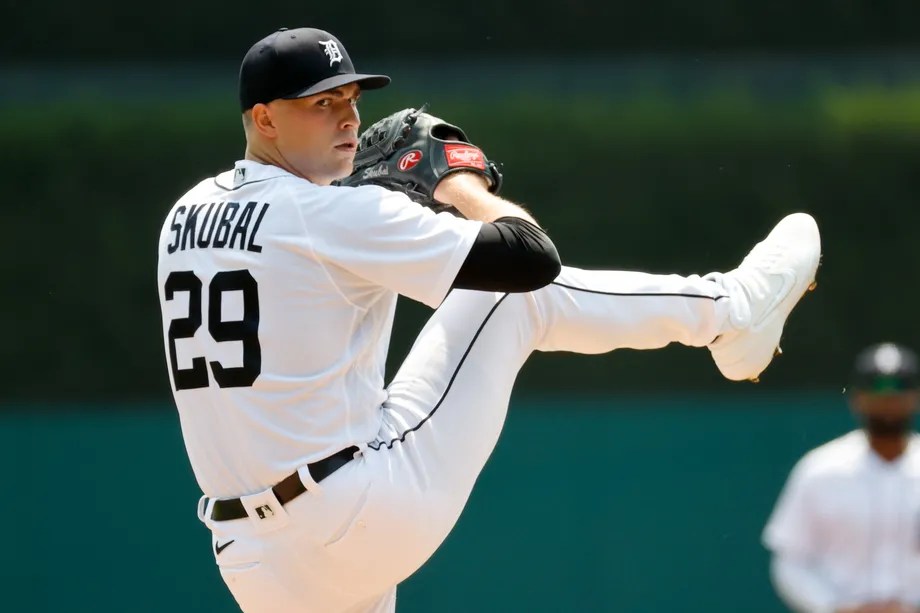
A piece from May 2022, unpublished at the time. Image credit: Rick Osentoski-USA TODAY Sports.

When you think of the Detroit Tigers, you think of Miggy, nightmare inducing logos, and losing. If you are the nostalgic type, you may reminisce of the 2014 rotation of Verlander, Scherzer, Price, and the gang or the deep playoff runs years prior to that. There has been renewed optimism with the recent crop of prospects; most notably Spencer Torkelson and Riley Greene this year, but the last couple years has also shown off Mize, Manning, and Skubal. Mize and Skubal both debuted in 2020 with Mize taking most of the fanfare due to his first overall pick expectations. Neither impressed in their short stints in 2020 nor in 2021 though there was progress to be built upon and Mize has been dealing with elbow issues. Our man of the hour has taken a step forward this year, living up to the prospect hype when he was the #5 Tigers prospect in 2020 and showing up the two pitchers ranked ahead of him that year.  

YearERAFIPxFIPSIERACSW%K-BB%HR/9GB%
20205.635.754.814.1225.519.42.5327.7
20214.345.094.063.9227.418.52.1138.5
20222.502.092.722.8127.623.30.4548.1
Tarik Skubal stats as of May 2022.

From the table above, we can see that Skubal has improved every year he’s been in the majors in every category listed with a big jump from last year to this year.  Since he was called up in 2020, he’s improved command, and steadily limited home runs while becoming a ground ball pitcher. In 2022, he’s only at 39.2 IP so far, so his home run rate is unsustainable, but even coming up to league average of 0.99 HR/9, he has halved what he was doing last year. He’s giving up barrels only 5.7% of the time and keeping hitters on their toes with a revitalized pitch mix that features an increased usage of a sinker and his slider as seen in the figure below.

Chart, line chart

Description automatically generated

The sinker has overtaken his 4-Seam as his most common 2-strike pitch and when behind in the count. This increased confidence in the pitch allows for more effective pitch tunneling and opens things up for his slider and changeup for the put away. The results of his sinker, however, show some regression is in order as it has a .375/.659 SLG/xSLG and .339/.464 WOBA/xWOBA, respectively. Even with this regression, it is performing better than his 4-Seam did last year so the transition has paid off presently. His 89 mph slider was and will continue to be his best weapon as long as he can continue to locate the 4-Seam up and use the sinker enough to keep up the tunneling illusion. 

The last point is his increased GB%, up to 48.1% and good for 16th in the majors this year. It is well known that it’s much easier to defend ground balls and they do less damage. From the table below, ground balls had a negative run value in 2014 with line drives being the most valuable at 0.34. (Weinstein, 2014 The Hardball Times)

Table

Description automatically generated

Skubal has only improved in this regard over the last three years and has shown the ability this year to continue the trend. He’s inducing anything but solid contact with a solid % of 2.8 and making hitters either get on top of the ball or under it which is a great indication of pitch mix and keeping the hitters on their toes. If he continues to pound the zone keeping eyes up on the 4-Seam and whipping them into the dirt with the slider/change he will continue this breakout even with spin rates that are below league average. The renewed command and control allows this breakout to persist and you won’t want to miss out while you can. 

Dunning-Kluber Effect 2022

In this series, I take a page from Big Magoo at Razzball and attempt to find some breakout pitchers akin to Corey Kluber in 2013.

To begin, the criteria for this type of breakout uses the following:

  • K/9 (2022 avg. 8.61) – ability to miss bats; we want this to be > 9.
  • SwStr% (2022 avg. 11.2%) – need to have good enough stuff to make batters want to swing; looking for > 12%.
  • GB% (2022 avg. 43.2%) – damage is most limited when balls are kept on the ground; using 44% as cutoff.
  • K/BB (2022 avg. 2.61) – allowing free passes only sets yourself up for disaster, we need some control; have to have more than a 3 here.
    • I’ve included CSW% from the folks at PitcherList (2022 avg. – 27.8%, Kluber 2013 – 29.8%) due to its strong predictive power, however, it is not part of the original Kluber breakout criteria.
NameTeamGSIPK/9SwStr%CSW%BB/9HR/9BABIPLOB%GB%HR/FBvFA (pi)ERAxERAFIPxFIP
Corbin BurnesMIL47270.112.5816.3%33.0%2.20.80.30278.60%48.40%12.30%95.12.762.372.47
Tyler GlasnowTBR3720612.6714.8%32.9%2.751.090.26381.90%45.00%15.20%97.22.802.872.78
Shane BieberCLE6741911.6415.0%32.5%2.211.120.29879.40%44.50%14.90%93.23.013.032.96
Tanner HouckBOS2092.110.4312.1%28.9%3.020.490.30070.50%48.00%7.60%94.53.222.853.37
Shane McClanahanTBR31155.210.8715.1%32.3%2.661.10.31979.20%47.90%16.50%96.93.353.272.94
Frankie MontasOAK663799.7612.7%28.9%2.731.020.29573.40%44.40%12.40%96.53.543.503.66
Alex WoodSF35179.19.4312.2%30.9%2.561.360.30672.50%48.20%19.00%90.14.424.183.67
Huascar YnoaATL24109.19.7112.7%29.3%3.051.480.29667.90%48.80%19.80%96.45.194.333.65
2019-2022

When we go back to 2019, including this year’s data, we find 8 names. A few names everyone knows, a rising star, and a couple that have begun to come around.

  • Burnes had a wondrous 2021 going 167 IP with a 2.43 ERA and winning the Cy Young along the way. It’s no surprise that he is keeping it up in 2022 continuing to dominate anyone thrown at him leading this group in SwStr%, CSW%, ERA, FIP, and xFIP. 2019 was not kind to him, but really started his breakout in the shortened 2020 season.
  • Glasnow was certainly on his way to making a case for AL Cy Young in 2021 before going down with Tommy John. Injury issues have plagued him his whole career but has found his next gear with Tampa and should rejoin the Cy conversation once he gets back.
  • Bieber is another Cy winner in this group in 2020 where he had an otherworldly 1.63 ERA. He had his true breakout in 2019 and has had some velocity concerns this year that have prevented him from maximizing his strikeouts, he’s one to watch for any subtle improvement to rebound to his top tier status.
  • Houck, the first of the new faces, has been a reliever transitioned to a starter and now seemingly back to the bullpen. His wicked slider brought him to the forefront of draft prep this year but has shown control issues that have limited his ceiling so far. Likely destined to stay in the bullpen, he’s a lower priority on the watch list.
  • McClanahan is the rising star to me out of this group. Bursting on to the scene in 2021 in 123 IP with a 3.43 ERA and a 10.29 K/9 he’s only improved in every regard so far this year in just over 30 IP. A high 90’s fastball and incredible slider gets him a K 36.7% of the time while only handing out a walk 7% of the time. Has some issues with game length and gives up a lot of hard contact but he is the real deal.
  • Montas is another candidate that has arguably already broken out with a great 2019, bad 2020, then recovery in 2021 with over 180 IP of 3.37 ERA ball. The split finger hurler garners loads of whiffs and is one to keep an eye on where he may end up at the trade deadline as Oakland will likely continue their fire sale.
  • Wood I let slip in as he turned 31 this year, he might deserve to be dropped if we want to be strict. He had a good stretch going in LA with the Dodgers, struggled in 2019 and 2020 in CIN then back to LA, and has since found his stride again in SF. At this point we know he’s a mid 3 ERA and about a K/IP.
  • Ynoa is the youngest on the list at 23, about to be 24, and has been struggling to stick in the majors. He’s been back and forth to AAA and can’t get below a 4 ERA. If we are looking for the true under the radar breakout, he is on that shortlist.
NameTeamGSIPK/9SwStr%CSW%BB/9HR/9BABIPLOB%GB%HR/FBvFA (pi)ERAxERAFIPxFIP
Corbin BurnesMIL638.211.6418.5%34.90%1.861.160.22292.30%46.50%16.10%95.01.862.592.972.34
Dylan CeaseCHW63412.4414.6%29.90%3.440.260.26777.40%45.30%3.20%96.82.381.771.952.77
Tylor MegillNYM633.19.7213.3%28.30%2.160.540.23877.20%45.20%7.10%95.72.432.712.442.76
Kyle WrightATL635.210.3512.5%31.50%2.780.50.31577.70%48.90%7.10%95.43.033.202.713.01
Shane McClanahanTBR632.113.0816.4%35.80%2.511.390.27380.80%59.20%29.40%97.63.063.023.131.81
2022

I’ve separated out 2022 data to help scout some potential trade targets. These 5 guys are all top 25 pitchers by xWOBA this year, so they are already hot commodities. If you need some pitching help, especially in keeper/dynasty leagues, these guys could be great adds.

  • Burnes is elite and shows no signs of slowing down.
  • Cease seems to finally be putting it all together this year, continuing his progress from last year, but now limiting walks and home runs so far this year. Granted, his HR/FB ratio is well below league average, he is utilizing a straighter fastball and better control to induce weak contact and loads of whiffs in his secondaries, a must buy.
  • Megill had a rough 90 IP last year with HR’s being his main issue. Cutting down on his walks and increasing his slider usage seems to have unlocked the next stage. Less active spin and a full tick increase on the 4-Seam has allowed him to focus up and away for righties and dropping the eye level with a sharp slider to keep things on the ground.
  • Wright has made appearances over the last few years but has not pitched well when he has. This year he’s lowered his 4-Seam usage and upped his curve usage to great effect. He’s on the right track for a good year, but maybe not quite the breakout we want.
  • McClanahan again is one of the best trade targets in baseball.

In conclusion, McClanahan and Cease are the best crop in the middle of a breakout, with Houck, Megill, and Wright showing potential. The other guys are well established as to who they are and should be treated as such. If you want to cast a slightly wider net, you can include 2018 data, lower the threshold for the stats, or even include relievers to find the elite setup man that could one day become a closer.

Diggin’ for Gold – Shane McClanahan

Welcome to the inaugural post of Diggin’ for Gold, where we do a deep dive on anyone and everyone to pan for gold and see if we can find the good ones. I’ve chosen to go about this at three different levels of inspection:

Surface level: This is the highest level view you can get looking at the most commonly used stats and comparing them to the player’s career norms and see how they’re doing this year comparatively. This will use stats most likely used by your scoring system (i.e. W, ERA, WHIP, K, SV for pitchers and AVG, R, HR, RBI, SB for hitters). From here, we can examine the landscape of the year so far to see if they’re seemingly breaking out, having a career year, going through one hell of a slump, or is just more of the same.

Prospecting: After we’ve gotten a feel of where to look to dig, we can start to use some more advanced stats to get a feel for any sort of potential regression. This is where things like xFIP, SIERA, and K%-BB% come in for pitchers and xBA, xWOBA, and BABIP are utilized for hitters, for example. At this point we should have more specific spots to dig even deeper to see if there’s a root cause for these numbers.

Search for the Motherlode: Once we’ve chosen a spot to focus on, we start to get into things like plate discipline and approach, pitch usage and effectiveness, quality of contact, etc. With these tools, we should have a decent idea if we are striking gold or finding nothing but dust.

We begin this series with Tampa Rays pitcher, Shane McClanahan. I first heard about him through PitcherList (a wonderful fantasy resource focused on pitching, but a plethora of other articles available you should check out) after he made his debut and was pushing 100 mph. Any time a starter pushes triple digits, it should garner your attention.

Credit: Twitter – @Sugar_ShaneM

On the surface with a line of 3.75 ERA – 1.25 WHIP – 6 W – 99 K in 84 IP, he doesn’t jump off the page as someone to be excited about. The 24 year old, drafted 31st overall in 2018, plowed through three different levels in 2019, ending at AA. There, he ended the year with an 8.35 ERA through 18.1 IP after a 1.46 ERA and 0.83 WHIP in 49.1 IP at high-A. Making his major league debut this year, we may be seeing the establishment of an absolute hurler on the mound for the Rays. With a 65 grade fastball and 60 grade curveball, per Fangraphs, he simply can overpower hitters if he can keep up his efficiency while pounding the strike zone with pitches that are all 5 mph faster than league average. Since he’s made his debut this year, let’s dig a little deeper and get a sense of the chances of his improvement on his surface line.

Moving on to some expected stats, we see that there is some positive improvement indicated but also some indicators that say this may be what we get in the future. A 4.12 xERA, a stat that considers how much contact is made and the quality of that contact, indicates that McClanahan is giving up a good amount of hard contact. This is supported by a 42.9% hard hit rate, above league average at 35.5%, and an average exit velocity of 91 mph verse 88.3 mph at league average. Per Baseball Savant, this puts him in the bottom 19th and 10th percentile, respectively. On that same Savant page, however, we can see his 33.6% whiff rate and 31.6% chase rate are some great numbers at the top 90th and 82nd percentile rank, respectively. This indicates that his stuff is good enough to rack up strikeouts and with some improvement on command, bring his hard hit rate down if he can locate in spots detrimental to hitter success.
McClanahan’s FIP and xFIP (stats that take into account events based on strikeouts, walks, hit by pitch, and flyballs) show as 3.56 and 3.29, respectively. When focusing on the outcomes that he can control, he has good room for improvement in the future. His HR/FB% is 16.2 which is above league average of 10%. If, and when, the home runs come under more control with improved command, a low 3’s ERA is not out of the question with the arsenal he brings to the table. SIERA, which is similar to xFIP but includes balls in play, also indicates an above average performance this season at 3.63 and optimism for even further success this year.

Now, my biggest concern is this quality of contact he’s given up this year. You can’t give up hard hits 42% of the time and expect sustained success. Taking a look at his approach, we can see a 65.6% first-strike percentage, above 60% league average. He begins 80% of his at-bats with a fastball (52.3%) or slider (27.7%). This gets him a swing 39.5% of the time on his fastballs and 32.7% of the time on his sliders. The bad news is hitters are batting .423 against his fastball and .444 against his sliders on the first pitch of the at-bat. If I’m a hitter facing him, I’m sitting fastball and swinging first pitch as he hits the zone with it 63.8% of the time. If you are unlucky enough to get to two-strikes, you sit slider and hope he leaves it hanging as you’ll probably whiff or make some weak contact. McClanahan is a primarily FB, SL pitcher but his CB and CH are good enough to keep you on your toes and put you away if you sit FB too often. This year, overall, his FB is getting swatted for a .301 average when he can’t command it as precisely as he wants and leaves it too much in the zone. I would love to see him throw his CB even more as he gets a whiff 43.3% of the time and is his biggest velocity difference from his FB.

In conclusion: Gold
McClanahan has the tools to take the next step forward as a high-end starter for the Rays. Once he gets his full endurance and starts going 6, 7, 8 IP per game, those K totals will start racking up. As long as he starts to more precisely locate his fastball and really help the velocity stand out, utilizes his curveball a tad more, and continues his aggressive first strike approach, he’s going to be a desired part of your staff for years to come.

The Staff – Kansas City Royals

Welcome to The Staff, the sister post to the Starting IX, where we’ll cover the starting rotation and a few names from the bullpen and minor leagues at-a-glance and see how they’ve done so far and what the future may hold. The rotation is chosen from Fangraphs’ Roster Resource and the bullpen and prospect names are chosen subjectively. Let’s get started! (Stats as of 7/9/21).

The Royals rotation was one of the main objectives to beef up this off-season as there are not many arms capable of going the full season with a lot of young talent quickly rising through the minors. The addition of Mike Minor and others was in hopes that the rejuvenated offense could provide enough oomph on the other side that the starters wouldn’t have to be perfect. This leads to a dependence on the bullpen, which has had its own ups and downs as we’ll discuss.

  1. Danny Duffy – 57 IP – 4 W – 2.53 ERA – 1.25 WHIP – 62 K
    • Duffman has had lofty expectations within the organization since 2014 in his breakout year. Some health issues have kept him from becoming the true workhorse that the rotation has needed in the last few years and hasn’t been able to put it all together for a consistently great year. A FIP/xFIP/SIERA all in the high 4’s the last three years compared to high 3’s and low 4’s this year along with a 9.79 K/9 show some legitimate improvements this year. The caveat being he’s only made 11 starts this year as he was out with a forearm issue. He will start to give up a few more HRs here and there as well as strand fewer runners. Another 50-60 IP with a high 3’s ERA and another 50-60 Ks is not out of the question. Duffy is a FA next year so will likely be on the trade block this deadline and a change of scenery could hurt him if he gets dealt to a worse ballpark.
  2. Brad Keller – 87.1 IP – 6 W – 6.39 ERA – 1.82 WHIP – 74 K
    • Keller has had the exact opposite of the kind of year he and the Royals were hoping for coming off a strong 2020. Unfortunately, there were clear signs that 2020 was a bit of a facade. A 4.82 SIERA, .233 BABIP, 5.76 K/9 and .33 HR/9 last year showed some luck and lack of true dominance compared to his 2.47 ERA and 1.02 WHIP. This year has been a true coming to form with FIP and SIERA in the high 4’s and a more normal 1.23 HR/9. Though the HR/FB % at 15 is below average and will regress a bit. A 10% barrel rate and .303 xBA and .390 xWOBA show poor contact against and he seems to be lost with how to change. Cal Eldred, pitching coach, even said as much when he said “I don’t know what to tell you” last month after conversing with Keller on what he can change. Not worth rostering at this rate.
  3. Mike Minor – 106.1 IP – 6 W – 5.67 ERA – 1.32 WHIP – 103 K
    • Minor had a career year with the Royals in 2017 over 77.2 IP with a 2.55 ERA and 1.02 WHIP and was brought back as a familiar face to provide veteran presence and eat some innings. He’s done just that, but unfortunately, it’s come with some poor ratios as only 8 of his 19 starts has he allowed 3 ER or less. A low 4’s FIP, SIERA, and xERA show some improvement could be in the cards but don’t put too much stock into it, he should still remain a Minor part of your portfolio.
  4. Brady Singer – 85.2 IP – 3 W – 4.52 ERA – 1.48 WHIP – 91 K
    • Part of the 2018 pitching mega-class for the Royals, Singer has been the first of the bunch to get a shot in the bigs. 64 innings last year and 85 so far this year show a high 3’s, low 4’s guy that K’s about a quarter of the guys he faces. A fastball/slider mix with the odd changeup thrown in, it has led some to believe he’s destined for a bullpen role if he doesn’t get the changeup to work. He will, of course, be given plenty of time to develop that third pitch as there is a dire need for starting pitching. As with Keller, the pitching development has been a problem at the major league level. Singer and his fellow 2018 classmates have all done well in the minors only to struggle at the highest level. It’ll be a wonder when/if Eldred ever gets let go and to see if the next coach can bring out the best in them.
  5. Kris Bubic – 56.2 IP – 2 W – 5.40 ERA – 1.59 WHIP – 48 K
    • Debuting a week after Singer last year, he got 50 innings in to the tune of mid 4’s FIP/SIERA and a 22% K rate. This year has been much of the same, but worse: xFIP and SIERA around 5, 19% K rate, walks up to almost 5 per 9. A 3-pitch mix with below average velocity on both FB and changeup and well below average spin rates have led to 45% hard hit rate, .373 xWOBA, and a .508 xSLG. He’s been relegated to the bullpen for now and will get another shot at the rotation in the future alongside his draft classmates.

Bullpen:

  • Scott Barlow – The best reliever so far this year with a 2.95 ERA and 32.6% K rate, he’s been in the mix for saves as part of Matheny’s committee. With great whiff/chase rates and xStats, he’s the one to have.
  • Josh Staumont – The flamethrower of the bullpen was expected to take over the closer role as he was the best at the time but injuries came to town and has thrown those plans for a loop. After a strong 2020, he’s not the one to own in the pen, Barlow or Holland will offer better opportunities for saves.
  • Daniel Lynch – Lynch got absolutely scorched in his first appearances in the bigs but has worked on fixing his pitching tipping and has continued to struggle in AAA. It may be another year before he begins to put it together again.
  • Jakob Junis – Back and forth between the rotation and bullpen as a long reliever the past few years, he was the odd man out with all the young blood call-ups. As the current rotation has soured, he could see another opportunity to make his stake to stay there.
  • Alec Marsh – A sneaky prospect starting to get a little more recognition after jumping to AA from rookie ball in 2019, his 4.97 ERA in 25 innings is a product of a .348 BABIP and 21.1% HR/FB rate. His eye-popping 39.6% K rate shows tremendous stuff, but a 12.3% BB rate shows some control issues that still need some work.
  • Asa Lacy – 45 innings in high-A after being drafted #4 overall last year, he’s shown, like Marsh, great K’s but poor control. Once he gets some semblance of control, he should move up quickly and debut late next year or early 2023.

Starting IX – Kansas City Royals

The purpose of the Starting IX series is to provide an at-a-glance rundown of the lineup most commonly utilized according to Fangraphs’ Roster Resource. Big names out due to injury and major prospects are also briefly discussed.

We open the 2021 Starting IX series with the hometown, small-market darling, Kansas City Royals. After a pair of brutal 100-loss seasons in 2018 and 2019, and a shortened 2020 campaign brought signs of improvement, 2021 was shaping up to be another year to garner much needed experience for the young blood while trying to pseudo-compete; a theme during current GM Dayton Moore’s tenure. The additions of familiar foes and old buddies from the good ole’ days helped the season begin in a positive light but has since tumbled to match the pessimistic expectations of past Kansas City teams. Let’s get started. (Stats as of July 9)

  1. Whit Merrifield (2B) – .275/.328/.414 – 50 R – 8 HR – 46 RBI – 24 SB
    • Leading the league in swipes while providing good R, RBI, and lineup versatility at 2B and OF has kept Mr. Merrifield a premium talent this year. A stellar 13% K rate and middling OBP keep him atop the Royals lineup to provide consistent, successful SB opportunities (24/25 attempts). Atrocious barrel (3.3%) and hard hit (28.8%) rates prevent him from reaching 25 HR ceiling, but 15 HR/40 SB at end of year is absolutely worth the price to win the SB category almost single-handedly. After a wonderful June (.351/.375/.544), July has been a bit cooler hitting .161/.257/.194 through 7 games. The second half ahead holds plentiful SB with a few more HR to boot. Whit is one of the Royals’ better trade pieces if they decide his 32 year-old self isn’t in the next window of contention but is unlikely to be moved this year as he’s a face of the franchise and is under contract through 2023. Heading to a contender with a more hitter-friendly ballpark could provide an extra 2-3 HR through the year to get closer to a 20/40 season.
  2. Andrew Benintendi (LF) – .268/.323/.417 – 32 R – 9 HR – 33 RBI – 7 SB
    • Currently a top-30 outfielder, Benintendi has provided some good value in roto leagues. After an awful April, he turned it around with a great month of May going .340/.377/.443 with 3 HR and 2 SB. A rib injury kept him down for half of June and is only hitting 1/16 in 4 games in July. The break should give him some time to rest and try and get back on a tear akin to May. ZiPS shows another 7 HR and 6 SB the rest of the way getting close to a 15/15 season with an average and counting stats that won’t kill you while hitting near the top of the lineup. He’s been caught 6/13 attempts so he could get his green light revoked if he continues to get caught at such a rate, something to be cautious of if chasing SB. Benintendi is right in his prime and has made some mechanical swing changes to get back to his more contact oriented ways of yore. Trading for him this offseason was the exact kind of move made to pseudo-compete as he will be a FA in 2023.
  3. Salvador Perez (C) – .278/.303/.500 – 40 R – 20 HR – 51 RBI – 0 SB
    • Salvy has been the face of the franchise with his beaming smile ever since he was called up. He’s 31 this year and is having a career year; on pace to almost double his previous highs, he’s the cream of the crop at the position. Absolutely crushes the ball evidenced by a 56.6% hard hit rate and 93 MPH average exit velocity but still K’s at a 26% clip and can’t walk to save his life (2.2 BB%). The best bat on the team in the prime 3-hole, hold every where if you invested in catcher. Under contract through 2026, he won’t be going anywhere unless the team commits to a full rebuild.
  4. Carlos Santana (1B) – .252/.373/.430 – 48 R – 15 HR – 50 RBI – 2 SB
    • A long-time nemesis of the Royals from his time on the Indians, Santana has been a great addition to the team to anchor 1B. The OBP machine that he is fits the Royals preferred playstyle and has provided veteran presence to some young players in the clubhouse (could give Salvy some tips on how to walk). His counting stats are close to repeating 2019 with almost 100 R, 30 HR, 100 RBI pace giving the team the best bat not named Salvy to anchor the clean-up spot. He has an xSLG .053 points higher than his current mark and an xHR four higher than his current count. Suffice to say we may not have seen the best Carlos yet this season. He’s no Vlad Jr., but he has filled the slot nicely this year.
  5. Ryan O’Hearn (DH) – .225/.265/.405 – 13 R – 6 HR – 13 RBI – 0 SB
    • The DH slot has been used mostly as a rotational spot to rest some guys as O’Hearn has only appeared in 35 games this year. He’s been tearing up AAA but can’t seem to put it together at the major league level. Destined to be a AAAA player that occasionally fills in when needed. Reach to roster even in AL-only.
  6. Jorge Soler (RF) – .183/.279/.309 – 25 R – 6 HR – 29 RBI – 0 SB
    • It’s difficult to put into words how disappointing of a season this is for Soler. Coming off a Royals record 48 HR in 2019, 2020 was going to be the follow-up to cement his role as DH in the middle of the lineup. He regressed a bit in average and was still on a 30 HR pace, but boy has 2021 been the fall from grace. He’s been bad, plain and simple. The walk rate, K rate, hard hit rate, etc. all are similar to his 2019 season. The biggest difference has been in his Pull%, LD%, and Barrel %. His pull percentage is up 7 points from that year, LD down 8 points and barrel down 5 points. He gets under the ball 9 points more often as well indicating that he’s simply trying to crank home runs and isn’t seeing the success of prior years. An xHR count of 12 compared to his current 6 is mainly a product of playing in spacious Kaufmann. If he hits the ball, it’ll be hard, but his defense and tangible results leave much to desire. He will not be on the team by the end of July at this rate whether he’ll be traded for pennies on the dollar or DFA’d.
  7. Hunter Dozier (3B) – .174/.241/.348 – 26 R – 8 HR – 26 RBI – 1 SB
    • If you thought Soler was bad, Dozier has been a doozy. Near the bottom of every category for qualified hitters, his 4 year/$25 MM contract will go down as one of the worst in GMDM’s tenure. Highest K rate of his career, one of the lowest walk rates, atrocious defense, and his .589 OPS should tell the organization he needs to change something up. Hanser Alberto and Emmanual Rivera have tried covering for him at the hot corner but have yet to stick. Like Soler, Dozier was coming off a great 2019 ready to contribute for the foreseeable future only to fall on his face last year and continuing into this year. Avoid at all costs.
  8. Michael A. Taylor (CF) – .246/.298/.371 – 34 R – 8 HR – 32 RBI – 6 SB
    • Brought in for cheap for speed and defense in CF, he has filled that role well. A hot start to the year boded well for a potential diamond in the rough but he has regressed to his standard ways of speed and defense. A better real life player than fantasy, he’ll continue to see time as he is the best defensive CF on the active roster but is a stretch for much more than a few SB here and there. At this spot in the lineup, runs and RBIs will be harder to come by, but if he heats up as he has in July, he could see a rise to the 2-spot pushing everyone else down one. Another potential trade chip to flip at the deadline as he’s a FA next year.
  9. Nicky Lopez (SS) – .263/.348/.326 – 35 R – 0 HR – 14 RBI – 8 SB
    • A substitute for the oft-injured Mondesi (more on him below), he brings to the table a similar skillset as Taylor: speed and defense. After cruising along the Mendoza line through mid-June, Lopez has turned it around to get to his current line. He walks at a good clip and strikes out less than half the league average rate, but makes almost no hard contact. Nicky’s contributions will be seen through his SB, but mainly defense, which doesn’t apply to fantasy, unfortunately. A versatile bench bat to quell the lineup fatigue when his main competition is healthy.

Injured dudes and prospects:

  • Adalberto Mondesi (SS) – the shortstop of the future if he can ever not be hurt. Elite speed and awesome power leaves us wanting more in chase of a 30/30 or even 30/40 season. Lucky to get 30 games this season at this rate but can win SB for you similar to Whit given enough playing time.
  • Edward Olivares (OF) – crushing AAA to the tune of .349/.421/.562 and being given the carousel treatment until Dozier or Soler gets gone. Power/speed combo that can be unleashed in the second half.
  • MJ Melendez (C) – huge power potential with a strong start to the year after a down 2019. Likely to be next in-line behind Salvy if he stays at catcher.
  • Nick Pratto (1B) – Similar to Melendez, a down 2019 has been put in hindsight with a strong rebound this year. Power and some speed that may not translate to the bigs, but a good walk rate and okay K rate will get him to replace Santana in the near future.
  • Bobby Witt Jr. (SS) – the uber prospect is crushing AA with superb power and speed combo and should be in AAA before the end of the year. Will easily take over for Mondesi if he can’t stay healthy.